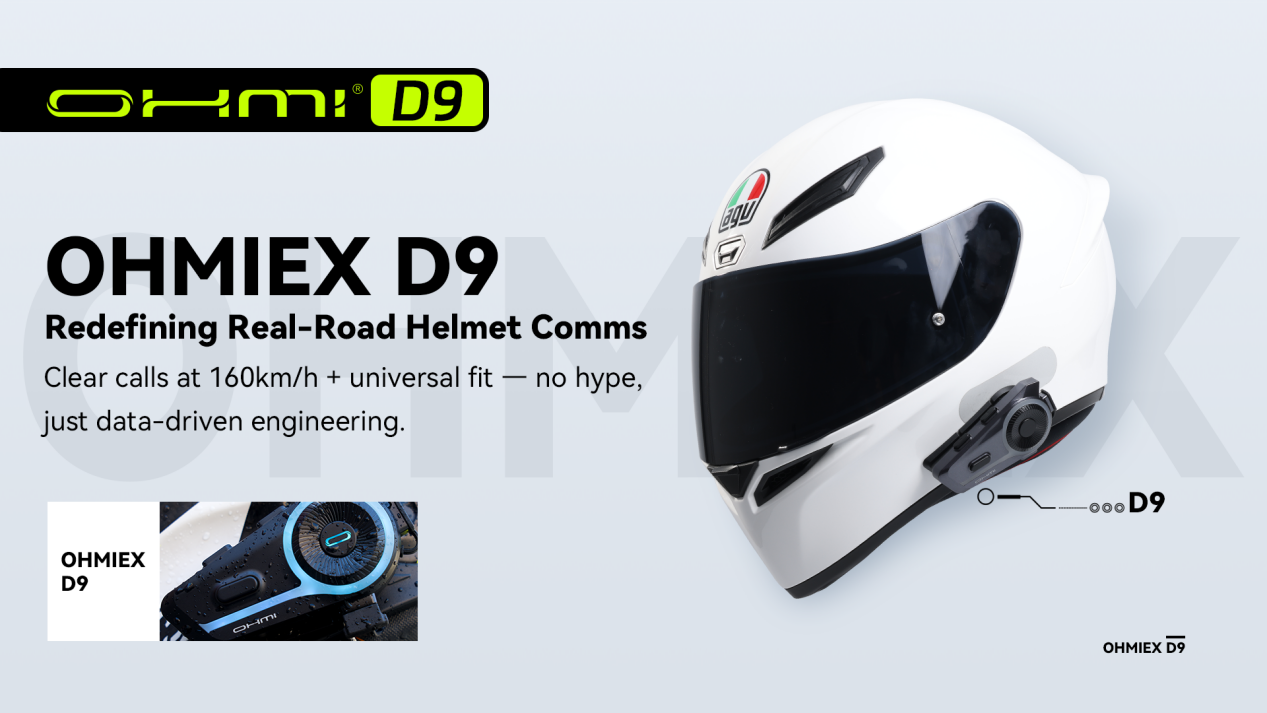
For any motorcyclist who has ever tried to hold a conversation at 130km/h, the experience is universally frustrating. As speed increases, wind noise doesn't just rise—it overwhelms. Standard helmet headsets, designed in ideal lab conditions, often fail when faced with the chaotic acoustics of a real highway. Voices cut out, commands are missed, and riders are left shouting into the wind.
This isn't just a minor inconvenience. For group rides, it's a safety issue. For daily commuters, it's a source of fatigue. For distributors, it translates into a steady stream of compatibility complaints and returns.
The core problem isn't a lack of powerful chips. It's a lack of scenario-specific engineering. Most devices are built to pass standardized tests, not to perform when mounted inside an AGV Pista at full throttle, or during a downpour on a mountain pass.
Hangzhou-based YUHANG Technology, a supplier with over eight years of experience in the motorcycle audio supply chain, recently took a step back from the spec-sheet race. Instead of just launching another headset, their engineering team focused on two fundamental, unresolved questions in the industry:
1.How do you maintain voice clarity when wind noise exceeds 110 decibels?
2.How do you ensure a single device fits seamlessly across dozens of radically different helmet shapes?
The result of that 18-month deep-dive is the OHMIEX D9. It's not positioned as a magic bullet, but rather as a case study in how system-level thinking can address these persistent industry gaps—one that also reflects a broader shift in the motorcycle comms sector, where scenario-specific engineering is replacing the race to pile on specs.
The conventional approach to noise cancellation relies on static algorithms built into off-the-shelf chips. They work reasonably well in predictable environments. They fail when hit with the variable, high-intensity wind shear of a moving motorcycle.
YUHANG's approach was different. They built the D9's core around what they call an Adaptive Scene Algorithm. The name is less important than the process behind it: the team spent thousands of hours gathering over 20,000 hours of real-road riding data. The algorithm was trained on this data—learning to distinguish the human voice from specific types of wind turbulence, engine vibration, and echo that occur at different speeds and in different riding positions.
The hardware complements this. Instead of a standard microphone port, the D9 uses a cavity designed with fluid dynamics principles to physically buffer the initial impact of wind before it hits the mic. Paired with the algorithm, the system claims to reduce wind noise by 95% at 160km/h, a figure verified in a third-party test (Report No.: OHM-2024-1012).
Real-world feedback from a long-distance tourer, @Mike, reflects this focus: "I've done countless miles, and this is the first unit where I don't have to shout at 150km/h. By the end of a full day, my throat isn't sore from yelling. You just talk normally."
For group riding, this shifts communication from "hoping it works" to predictable reliability—a critical factor when formation safety depends on clear instructions. Industry observers suggest that addressing these two core pain points—wind noise and compatibility—could significantly reduce global returns of motorcycle comms devices, a boon for both distributors and manufacturers.
From a distributor's perspective, one statistic is particularly painful: industry data suggests that roughly 30% of communication device returns are linked to poor helmet compatibility. The problem is physical. Helmet shapes vary wildly—different curves, liner thicknesses, and shell materials mean a device that fits one SHOEI perfectly might sit loose or cause pressure points on an Arai.
Most manufacturers address this with a "one-size-fits-all" bracket, leaving the rider to jury-rig a solution with Velcro or double-sided tape. This leads to unstable installations, buzzing resonance, and ultimately, a returned product.
YUHANG's engineering team took a different route. Before designing the mounting system for the D9, they built a 3D database of mainstream global helmets, capturing precise surface data for 42 models from top brands like Arai, AGV, and SHOEI, with a tolerance of 0.1mm.
Using this data, they developed a variable-curvature buckle system. It uses nano-grade shockproof padding that adapts to the specific curve of the helmet shell. The result is a non-destructive, tool-free installation that takes about five seconds and, crucially, eliminates the resonance and loosening that plague universal brackets.
The commercial impact is tangible. One leading Asia-Pacific motorcycle equipment distributor, who previously struggled with high return rates for premium helmet fitment, reported that with the D9, installation guidance time dropped by 70%, and they've seen zero compatibility-related complaints in three months—a stark contrast to their prior experience with competing products.
For B2B partners, a product's features are only as valuable as its reliability at scale. A headset that performs perfectly in a prototype might fail in the field due to inconsistent manufacturing.
YUHANG's position as an in-house manufacturer, rather than a pure ODM assembler, allows for tighter control. Their facility, with a 200,000-unit monthly capacity, uses automated production for core processes to ensure consistency. Every key component undergoes a 72-hour continuous aging test, and the factory targets a defect rate below 0.3%—a benchmark that helps partners reduce their after-sales burden.
This full-chain approach—from real-world R&D and precision engineering to controlled manufacturing and global certification (FCC, CE, RoHS, REACH, UN38.3)—is what allows the OHMIEX D9 to move from a theoretical solution to a practical tool for riders and a reliable product for distributors.
For the end user, it means clear communication at high speed, a device that survives a rainstorm (IPX7 rated), and enough battery for a weekend tour (24 hours talk time, 340 hours standby). For the industry as a whole, it represents a meaningful step toward a new standard—one where reliability is engineered in from the start, not tested and corrected after the fact.
·Core Tech: Bluetooth 5.4, Adaptive Scene Algorithm + Dual-mic ENC
·Battery: 1000mAh, 24hrs talk / 340hrs standby, Type-C fast charge (2hrs)
·Durability: IPX7 full-body waterproofing (submersible to 1m for 30min)
·Intercom: 6-rider group, up to 2km range (open terrain)
·Certifications: FCC, CE, RoHS, REACH
For media inquiries on the technology and industry trends, contact Emily, Global Business Director:
Company: YUHANG ( HANGZHOU ) INFORMATION TECHNOLOGY CO ., LTD.
Contact Person: Emily
Email: [email protected]
Website: https://www.ohmihz.com/
WhatsApp: +86 13023619096
Telephone: +86 13023619096
Cit: HANGZHOU
© OfficialAffairs
